
My work is rooted in ontological coaching, shaped by my training with the Newfield Network. This lineage traces back to the pioneering work of Julio Olalla, whose vision and teaching have been carried forward by his daughter Veronica Olalla Love and her partner Alexander Love.
The training I received has been transformative for me personally, while also giving me the tools and insights to stand powerfully for transformation in others.
Lars Meyer
Julio Olalla’s work emerges from the broader ontological tradition and its early collaborators. Many of the ideas and practices within this field have also influenced other schools of personal development — including the Landmark Worldwide and the Landmark Forum, where I’ve been a participant, a coach and trainer.
I’ve also been deeply influenced by the work and way of being of my friend and client Christopher Kinman and the Rhizome Network, whose focus on relational ways of knowing and community continues to shape how I understand this work.
At its heart, the ontological approach to coaching is about shifting how the world occurs to you — how you observe, interpret, and act in life.
“Ontology is the study of how we are being in life — how we are showing up in life.”
Ontological coaching begins with this simple but profound idea. As Veronica Olalla Love explains, it is “a cultivation practice in awareness, in observing our own being in relation to self, to others, and to the world.”
At Newfield, this exploration unfolds through three interrelated realms of the self: emotions, language, and the body.
Rather than treating emotions as something to get over, ontological coaching recognizes them as part of the weave of life.
“The more emotional integrity, the more emotional understanding and awareness we have, the deeper our capacity to live fully.”
Emotions are what “put us into action,” shaping how we respond to life and the possibilities we see.
“We look at our internal dialogues, the stories we tell ourselves, and the cultural stories that are often transparent — we don’t even notice they’re there.”
Language is not just descriptive; it is generative. Through language, we create, coordinate, and bring new realities into being.
“When I say, ‘I’ll meet you at that restaurant tomorrow at 2,’ with you confirming, my future and my present have changed — and so have yours.”
By becoming more conscious of how we speak, listen, and interpret, we open new possibilities for action and relationship.
“How do we inhabit our own physiology, our biology? How are we in our bodies?”
Our body tells its own story. The way we stand, breathe, and move reveals—and influences—how we engage with the world.
“Even if I say the same words, the meaning changes when my body is upright, open, and connected versus collapsed or withdrawn.”
Awareness of the body’s role in communication brings greater authenticity and coherence to how we live and relate.
These three realms—emotion, language, and body—interact continuously to form what Olalla Love calls a “dynamic coherence — the wholeness of who we are.”
Ontological coaching helps us reconnect with that wholeness and cultivate a deeper freedom to “show up authentically, connecting heart, intelligence, and gut on all levels.”
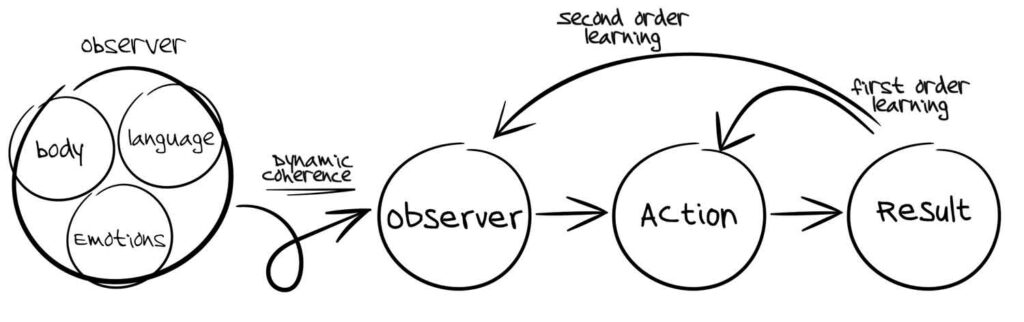
In my coaching, I draw directly from these teachings while integrating other influences that have shaped my understanding of human transformation.
The ontological approach invites us to explore three interrelated domains of our experience:
Together, these practices open space for profound change. Along the way, we may also touch on the influence of your history, culture, and background—each of which shapes the lens through which you see yourself and the world.
It’s important to note that while coaching—and ontological coaching in particular—can sometimes feel similar to therapy, it is not therapy. Coaching is distinct from psychology and psychiatry, though the benefits may overlap: increased clarity, emotional freedom, new perspectives, and the ability to take action aligned with your deepest commitments.
If you’d like to experience this work firsthand, I invite you to book a free 30-minute conversation. In that call, I’ll share more about the ontological approach, you’ll get a sense of who I am and how I work, and you’ll have the opportunity to freely decide whether you’d like to move forward with a first coaching session.
I want to acknowledge Christopher Kinman for inviting me onto his team to work on the documentary about Lynn Hoffman’s life and her contributions to the field of family therapy. That project introduced me to Lynn’s remarkable work with ShareVision, Ellen Landis, and Lisa Thompson, as well as to Mary Olson and her leadership in bringing Dialogic Practice and the Open Dialogue approach from Finland to the United States.
Working with all of these people has deeply shaped how I see transformational work—both in individual lives and in community settings. Their influence continues to remind me that the quality of our conversations, our listening, and our presence with one another are the foundation of meaningful change.
“Coaching is personal, so the best way to know if it’s right for you is to talk. Let’s set up a free 30-minute call. You’ll get a feel for what ontological coaching is and what a session with me is like.”
The Ontological Approach to Coaching
Ontology means “the study of being.” Coaching from this perspective invites you to shift not just what you do, but how you see and experience the world.
Next Steps & Questions
If it feels like the right fit, we’ll look at options for ongoing sessions, talk through pricing, and make space for any questions you’d like to ask.