
By Christopher J. Kinman
With a foreword by Lynn Hoffman
How can we honour community when the systems around us are organized around management and deficit?
Through essays, poetry, satire, and encounters from human services, Kinman explores the politics of the gift—and the possibilities that emerge when we respond to the relationships already sustaining life.
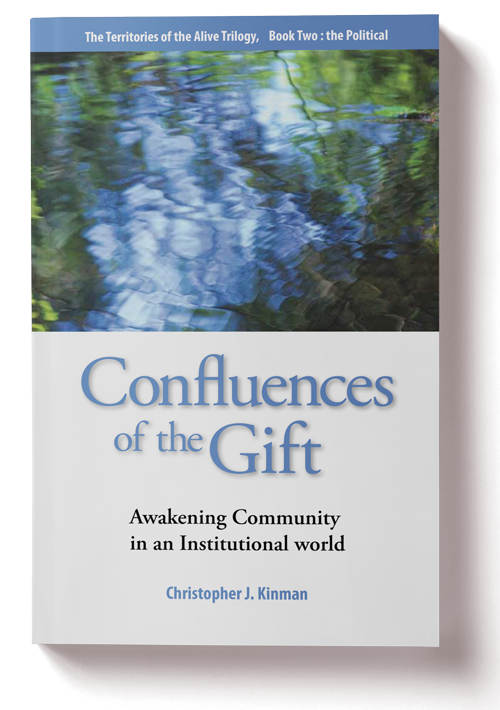
Gifts, relationships, and the possibilities of life together.
Part II of The Territories of the Alive Trilogy.
A family and its workers become caught in a cycle of accusation. A practitioner wants to offer care but struggles against the demands of management. The language of problems grows louder, while the gifts moving through people’s lives become harder to see.
In Confluences of the Gift, Christopher J. Kinman enters these contested places. Drawing on family therapy, philosophy, communal practice, and the living world, he examines how human services can reproduce deficit and enemy-making—and how other forms of relationship can emerge.
The book moves between reflective essays, poetry, satire, and practical principles for organizational life. Rivers, crabgrass, touch, and Bill Reid’s The Spirit of Haida Gwaii become companions to an inquiry into how we live and work together.
Kinman invites readers to develop a responsive understanding of gifts and the obstacles to their circulation. For those who feel the tension between institutional requirements and communal care, these pages offer intellectual provocation, possibilities for practice, and encouragement to continue.
Notice the goods people exchange through everyday life. Create occasions for those contributions to be seen, heard, and honoured.
Bring individuals, families, and significant members of their communities into planning, action, and evaluation.
Let services adapt to the lives they encounter. Kinman places organizational responsiveness above program consistency.
Examine how institutions can depend on descriptions of lack—and how those descriptions can perpetuate the demand for services.
Look for ways of acting within conflict that do not continually reproduce opposing camps of friends and enemies.
Attend to connections across generations, places, nature, and memory. The alive exceeds what an institution can classify or contain.
Ideas explored in “Enemies and Friends,” “Aliveness and the Rhizome,” and “From Mission To Practice.”
Kinman asks what happens when the work of helping depends on finding something wrong. In his critique, deficit becomes more than a description: it can become the basis of an institution’s economy, authority, and continuing activity.
Gift-centred practice attends to what is already moving between people—their knowledge, abilities, loyalties, and contributions. Problems are understood in relation to the gifts they restrain. Work begins by making these gifts visible and creating opportunities to exercise them in communal life.
This attention includes hardship. In “Why No Colours?” Kinman insists that action in response to suffering must keep the beauty, powers, and loves of people and their places in view.
What gifts are already circulating here—and what is preventing them from being recognized or shared?
A question to bring to supervision, planning, or a conversation with a family.
The introduction takes the phrase managed care seriously enough to question it. Kinman explores how care becomes detached from communal life when it is organized as a product under the numerical gaze of management.
His response reaches into organizational practice. “From Mission To Practice” argues for flexible services, recognition of lived wisdom, family involvement, and the least intrusive action necessary. People and their communities should participate in decisions that directly affect their lives.
In her foreword, Lynn Hoffman recalls public health nurses adapting gift-oriented work, with participation from administrators, educators, and a mother speaking for herself. Her account offers a concrete glimpse of change moving across the relationships of a health system.
From frontline encounters to organizational decisions: where can the gifts of a community become visible?
Crabgrass returns. Termites make passages through solid structures. Prairie sod holds together through countless interwoven lines. Kinman draws on these images to explore the rhizome: a world of multiple connections, movement, and unexpected renewal.
The alive moves through bodies, conversation, memory, and touch. Its relationships extend beyond the boundaries by which institutions divide and describe a life. Nature is part of this inquiry, with formative connections that reach through communities and generations.
Kinman also resists turning the contrast between institution and rhizome into another simple battle of good against evil. These images invite experimentation with how we see and respond to life, including its disorder, conflict, and abundance.
“Aliveness and the Rhizome” brings philosophical inquiry into contact with the persistent, surprising movements of the living world.
“Enemies and Friends” begins with painful encounters in child welfare and asks how relationships become organized around conflict. Kinman brings political philosophy into the everyday world of human services, examining the ties that form when people identify someone to oppose.
“Appropriation and the Political” carries the inquiry further. What happens when we desire an authority that will finally put everything right? How might political action arise instead through informal relationships, the recognition of gifts, and a response to the struggles of others?
Kinman leaves room for occasions of political battle, while asking that they be approached with self-questioning and a continuing search for responsive alternatives. His relational politics attends to what people can create together within the particular circumstances of their lives.
Three short passages from the 2011 second edition of Confluences of the Gift.
“Responsivity must be a higher organizational value than program consistency.”
— Christopher J. Kinman
From Mission To Practice
An invitation to let organizational practice fit the lives and relationships it serves.
“Everything exists in relationship and in motion, including the work we engage in.”
— Christopher J. Kinman
Creating a Relational Work – I
Relational practice begins within a moving web of connections.
“We never move anywhere on our own through life, it is forever a communal event.”
— Christopher J. Kinman
Creating a Relational Work – II
Reflecting on Bill Reid’s The Spirit of Haida Gwaii, Kinman attends to the fullness and friction of life together.
Kinman addresses service providers, administrators, people receiving services, and citizens who have felt the tension between institutional requirements and communal action.
The book asks for thoughtful engagement. Its shifts between essay, poem, humour, and philosophical exploration invite readers to make connections across their own experience.
Bring a chapter to a reading group, supervision session, or team conversation. Begin with three questions: Where are we reproducing an enemy? Which gifts are we overlooking? What would a responsive action look like here?
The Territories of the Alive Trilogy brings together three books concerned with gifts, community, professional life, and the alive.
Honouring Community in Professional Practice
Awakening Community in an Institutional World
Part II — The Political. The book featured on this page.
Meditations on the Alive in a Secular World
Christopher J. Kinman is a family therapist, photographer, poet, and writer whose work follows connections among people, communities, and the living world.
The author biography in this edition describes his work as a consultant to human service organizations, speaker, and workshop presenter. His writing brings voices and friendships into relation with rivers, trees, birds, and other forms of life.
Title: Confluences of the Gift
Subtitle: Awakening Community in an Institutional World
Author: Christopher J. Kinman
Series: The Territories of the Alive Trilogy
Volume: Part II — The Political
Foreword: Lynn Hoffman
Edition: Second edition, 2011
Publisher: Rhizome Productions, Vancouver
ISBN: 978-1-77084-104-8
Details identify the edition featured here. Available purchase formats and pricing will appear below.
Discover Confluences of the Gift and make space to reconsider community, care, and the relationships at the heart of your work.
Purchase link coming soon.
Retailer, available formats, and pricing will be added here.