
By Christopher J. Kinman
With forewords by Laura Calderón de la Barca and Alan Parry
What might we discover by attending more closely to the life already around us?
Through short essays, poetry, and encounters with the living world, Christopher J. Kinman explores abundance, relationship, and the gift as movement—a secular inquiry into the experience of being alive.
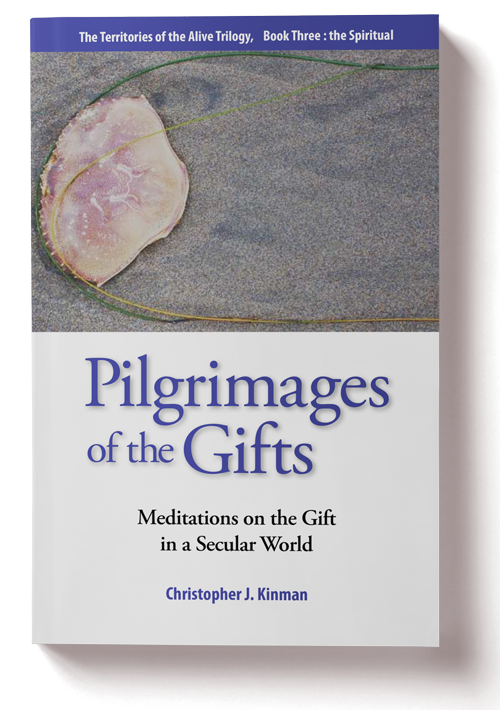
A rocky beach. A shared silence. A world of connections.
A walk through the forest with a young person. Creatures beneath our feet on a rocky beach. A cat’s gaze interrupting a working day. In Pilgrimages of the Gift, such encounters become openings into questions about how we perceive, think, and live.
The third volume of The Territories of the Alive Trilogy explores the spirituality of the gift through life as it is encountered. Kinman looks for ways of thinking that emerge within relationships with people and nature, questioning authorities that claim a position above or outside that living world.
Brief meditations and poems move among abundance, becoming, language, touch, creativity, and the future. Philosophical companions include Deleuze, Bateson, and Nietzsche; literary voices help draw attention to what ordinary perception can overlook.
This is a book to return to in fragments as well as to read through. An image or a small distinction can travel into the reader’s own experience, inviting a renewed attention to the people, places, and other lives close at hand.
Look closely at the variety and movement of everyday life, including details that escape our usual notice.
Consider how gifts change form as they pass through people, relationships, and the natural world.
Explore the rhizome as an image of linked lives, with possibilities emerging at junctions and encounters.
Question fixed descriptions that limit what a person or a relationship might become.
Attend to shared movement, silence, sensation, and the bodily experience of being together.
Let thought and language return to lived experience, where responses can become new acts of creation.
The opening meditations direct attention toward life’s profusion: birds, weeds, music, a child’s encounters, and the details of a beach. Abundance can be joyful or overwhelming. It asks us to notice complexity and variation rather than hurry toward a simplified account.
In “Listening and Seeing,” Kinman turns toward the ordinary and overlooked. Perception involves a willingness to encounter particulars that may trouble our expectations and expand what we can imagine.
For readers, the invitation is close at hand: linger with what is already present and consider what becomes visible when attention changes.
What detail in the place around you has become newly visible?
A reflection inspired by the book.
“The Gift – I” distinguishes a gift understood as a possession from a gift understood through its movement. A bottle of wine offered in response to a dinner invitation can become hospitality, appreciation, and further occasions of connection.
The same inquiry reaches into qualities such as compassion. Kinman follows their relationships to earlier gifts and future exchanges, attending to the many people and circumstances through which they take form.
“The Gift – II” places this perspective alongside charity and poverty. Kinman’s argument for abundance includes a concern for the ways poverty restricts the gifts already circulating within lives and communities.
What have you received that is finding another form in what you pass on?
A reflection inspired by the book.
The subtitle’s secular world is central to the book. Kinman explores what becomes possible when thought stays with earthly life, including our kinship with animals, plants, places, and one another.
His use of the alive points toward an experience sensed in relationship and engagement. Rooms, roads, weather, memory, and human creations join the inquiry alongside organisms and natural places.
In “Pure Immanence,” philosophical reflection returns to intimate encounters: a child at play, people gathering around a life in danger, the gaze of a cat. These images invite attention to life in the particular moment of its living.
Where do you experience a place or encounter becoming more alive?
A reflection inspired by the book.
In “The Beautiful Imperfection of Words,” Kinman recalls working with a young person who spoke very little. Shared walks and attention to the forest opened a connection that challenged his assumptions about therapeutic conversation.
“And/Is” explores the difference between fixing something within an identity and allowing further connections to form. Kinman uses this as a metaphor for thought and action, while acknowledging that language cannot simply be purified of one troublesome word.
Across the book, words, images, and experiments become ways to participate in life’s movement. The inquiry gives readers room to reflect on how their own descriptions can invite or restrict possibilities.
What might change if a familiar description were allowed to open into something more?
A reflection inspired by the book.
Selected short passages from the 2011 second edition.
“The gift is always in response to an encounter with abundance.”
— Christopher J. Kinman
The Gift – II
Response begins with the gifts already present.
“Neither wealth nor poverty guarantees a connection to the alive.”
— Christopher J. Kinman
Alive
The experience of the alive asks for attention to relationship.
“The whole meaning of talk was transformed for me, talk became something inextricably connected with, and never transcendent to our joint walking and seeing.”
— Christopher J. Kinman
The Beautiful Imperfection of Words
Shared experience gives language somewhere to return.
Choose one meditation and let each reader bring an encounter it recalls. Ask: what did we notice, what moved us, and what further connections did the reading make possible?
Three connected inquiries into the practice, politics, and spirituality of the gift.
Honouring Community in Professional Practice
I · The practice of the gift.
Awakening Community in an Institutional World
II · The politics of the gift.
Meditations on the Alive in a Secular World
III · The spirituality of the gift — the book featured here.
Christopher J. Kinman is a family therapist, photographer, poet, and writer whose work follows connections among people, communities, and the living world.
The author biography in this edition describes his work as a consultant to human service organizations, speaker, and workshop presenter. His writing brings voices and friendships into relation with rivers, trees, birds, and other forms of life.
Title: Pilgrimages of the Gift
Subtitle: Meditations on the Alive in a Secular World
Author: Christopher J. Kinman
Series: The Territories of the Alive Trilogy
Volume: Part III — The spirituality of the gift
Forewords: Laura Calderón de la Barca and Alan Parry
Edition: Second edition, 2011
Publisher: Rhizome Productions, Vancouver
ISBN: 978-1-77084-105-5
Details identify the edition featured here. Available purchase formats and pricing will appear below.
Explore meditations that bring the gift into conversation with nature, language, relationship, and the experience of being alive.
Purchase link coming soon.
Retailer, available formats, and pricing will be added here.