
By Christopher J. Kinman
With a foreword by Cami Ostman
What changes when professional practice begins with the gifts already moving through a community?
Christopher J. Kinman brings the rhizome and gift exchange into the work of human services, connecting philosophical inquiry with reflecting teams, communal listening, and Collaborative Action Planning.
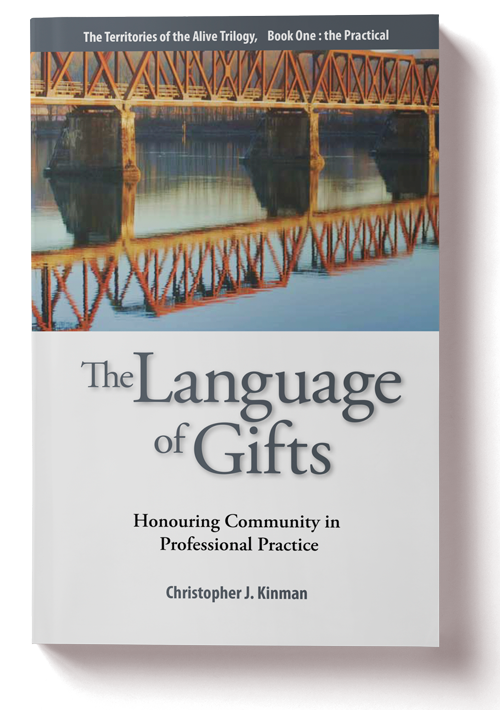
Recognizing gifts. Inviting response. Making room for community.
When a person enters a service, the conversation often begins with what is wrong. The Language of Gifts asks practitioners to become curious about a wider world: the relationships, histories, abilities, and contributions already sustaining that person’s life.
Kinman develops two images that guide the inquiry. The rhizome brings attention to connections spreading beyond institutional hierarchies. Gift exchange draws attention to the goods moving through those connections—and to the responses they invite.
The book moves from a broad exploration of community, tragedy, language, and institutional life into detailed accounts of practice. Its second part introduces reflecting-team conversations and Collaborative Action Planning, including a planning framework and questions for discovering gifts with individuals, families, and their communities.
For readers who want their work to honour the people and relationships it encounters, this opening volume offers both a perspective to think with and concrete processes to explore.
Follow the practices, histories, relationships, and other goods that contribute to communal life.
Notice how another person’s words and presence affect you, and speak from that response.
Look beyond the practitioner–client encounter to people who can witness, respond, and contribute.
Community develops through encounters between distinct experiences, with possibilities that no one person can supply.
Explore what could become possible when existing gifts find new occasions for expression.
Connect gifts, potentials, roadblocks, community contributions, and celebration in a shared planning process.
A gift may be a story, a skill, a relationship, a tradition, or something that takes shape in a particular encounter. Kinman resists reducing this abundance to a catalogue of personal strengths. Gifts become meaningful through their circulation and through the responses of others.
His attention to the gift also includes suffering. “The Gift and Tragedy” asks how people might respond to disaster without imagining those affected as living in an empty world. Courage, connection, grief, and compassion remain part of the encounter.
In the planning chapters, difficulties are explored as roadblocks to the expression and circulation of gifts. This changes the starting point for a conversation about action: what is already here, and what could help it move?
Whose contributions might we notice if we listened beyond the description of the problem?
A reflection inspired by the book.
A service has procedures, boundaries, and an organizational life of its own. A community lives through shifting relationships. Kinman explores the tensions between these forms of connection and asks how professionals can work with greater regard for communal life.
The book invites an awareness of the damage institutional practices can do, alongside attention to practitioners whose work creates room for friendship, response, and participation. Honouring community requires ongoing self-questioning and an ear turned toward what happens beyond the service.
For a team, this becomes a practical inquiry into whose knowledge is heard and which relationships its everyday routines help to sustain.
Which people and places already matter to the person we are working alongside?
A reflection inspired by the book.
Kinman brings Deleuze and Guattari’s image of the rhizome into conversation with the work of human services. Connections can extend in many directions, form new junctions, and draw people into possibilities beyond an organizational chart.
Response is central to this way of working. In “A Responsive Community,” language becomes a bodily experience: words can touch, strike, and move us. Listening involves noticing those effects and allowing a response to emerge.
The inquiry also reaches beyond talk. Walking, eating, sharing an activity, or simply spending time together can allow connections to develop. This matters especially where conventional interviews offer little room for a person’s voice.
How are we being moved by this encounter, and what response does it invite?
A reflection inspired by the book.
The Reflecting Team. Kinman describes a conversational process in which participants take turns speaking, listening, and reflecting on what touched or moved them. Recognition expands through the group and can travel into relationships beyond the room.
Collaborative Action Planning. Four chapters introduce a process organized around five elements: gifts, potentials, roadblocks, community contributions, and community celebration. The book includes conversational questions and ways to connect the plan with a person’s history and wider relationships.
Kinman presents this as one useful approach, open to adaptation. He emphasizes care in eliciting gifts, entry only into conversations where the practitioner is invited, and other ways of listening when direct questioning does not fit.
What could members of this community contribute to the possibilities they have helped identify?
A reflection inspired by the book.
Selected short passages from the 2011 second edition.
“Gifts are verbs — they only come to be in movement.”
— Christopher J. Kinman
What is a Gift
The gift takes shape in its circulation.
“All gifts are about response.”
— Christopher J. Kinman
A Responsive Community
Listening creates an opening for a response.
“We only enter into those conversations in which we are invited to go.”
— Christopher J. Kinman
Collaborative Action Planning – II
Respect for invitation belongs within the practice itself.
Read the opening discussion of rhizome and gift exchange alongside a practice chapter. Ask: which gifts have we already recognized, who else could help us see them, and what shared action could follow?
Three connected inquiries into the practice, politics, and spirituality of the gift.
Honouring Community in Professional Practice
I · The practice of the gift — the book featured here.
Awakening Community in an Institutional World
II · The politics of the gift.
Meditations on the Alive in a Secular World
III · The spirituality of the gift.
Christopher J. Kinman is a family therapist, photographer, poet, and writer whose work follows connections among people, communities, and the living world.
The author biography in this edition describes his work as a consultant to human service organizations, speaker, and workshop presenter. His writing brings voices and friendships into relation with rivers, trees, birds, and other forms of life.
Title: The Language of Gifts
Subtitle: Honouring Community in Professional Practice
Author: Christopher J. Kinman
Series: The Territories of the Alive Trilogy
Volume: Part I — The Practical
Foreword: Cami Ostman
Edition: Second edition, 2011
Publisher: Rhizome Productions, Vancouver
ISBN: To be confirmed
Details identify the edition featured here. Available purchase formats and pricing will appear below.
Explore ways of listening, planning, and working that make the contributions of people and their communities visible.
Purchase link coming soon.
Retailer, available formats, and pricing will be added here.