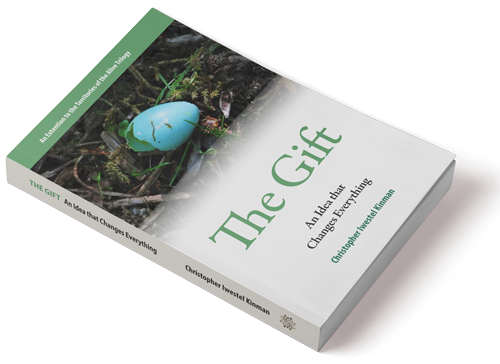
THE NEWEST BOOK BY CHRISTOPHER IWESTEL KINMAN
A shared meal. A child’s curiosity. A kindness that continues long after its giver is gone.
What changes when we notice the gifts already moving through our lives—and the relationships that hold us in life?
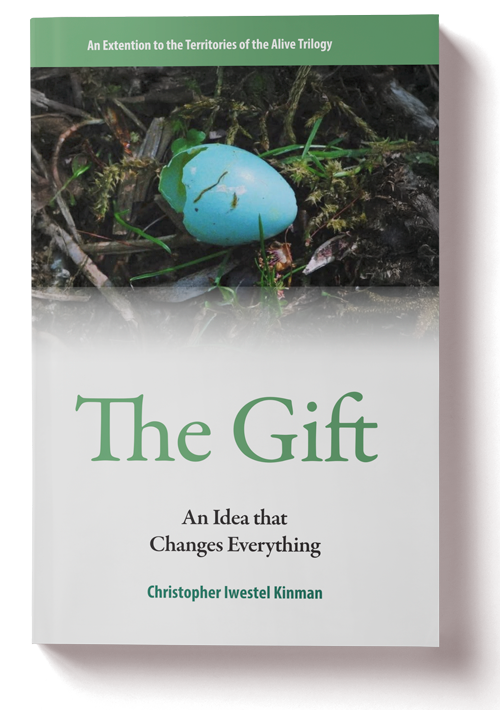
First edition · 2026
With forewords by Imelda McCarthy and Tom Strong
We arrive in a world already giving: language, food, care, stories, places to belong. What we receive changes form as it moves through us. A parent’s patience becomes a child’s way of listening. An invitation becomes a meal, a conversation, another possibility.
In The Gift, Christopher Iwestel Kinman follows these movements through a lifetime of therapeutic work, philosophical inquiry, and relationships with people and place. He invites us to notice what sustains a life, to respond to what has been given, and to help its possibilities continue.
“The gift is never about giving, it is always about responding to what has already been given.”
— Christopher Iwestel Kinman
Aphorisms of the Gift, p. 18
A LIFE IN RELATIONSHIP
A gift, in Kinman’s account, is always in movement. It passes through bodies, changes shape, and becomes part of other relationships. Its paths extend through people, creatures, land, ideas, and generations.
This perspective brings care into a wider field of attention. Alongside a person’s suffering, we can notice their friendships, the places and histories that matter to them, and the contributions others recognize in their presence. These connections become part of how we listen and respond.
The book combines aphorisms, personal stories, poetry, philosophical reflection, theology, and conversations. Friends and colleagues extend its inquiry through their own experiences and points of difference. The result is a many-voiced exploration of belonging, power, creativity, and love.
Kinman’s reflections on serious illness give the work an intimate urgency. As he considers the relationships that sustain him, the book becomes an offering to those people and places—and to the gifts that may continue beyond an individual lifetime.
The introduction begins with Pallavi, a practicum student in India. She tells Kinman about meeting another mother and her baby in a store. Amid the mother’s struggles, Pallavi notices love and beauty; she offers encouragement and holds the child.
Their conversation turns to food. Pallavi describes how leftovers in her community feed animals and birds. Kinman follows the gift from the earth to people and other creatures, then onward through the conversation, the writing, and the reader.
An ordinary encounter becomes a way to see an ecology: relationships already active, with new connections forming as someone responds.
The meal. The invitation. The care offered in passing.
An invitation to notice how a small encounter can belong to a much larger movement.
An invitation becomes hospitality. Hospitality becomes gratitude, conversation, or another act of care. The gift keeps moving as its form changes.
Look for what is already sustaining a person: relationships, interests, histories, places, and the goods they bring into other lives.
Animals, plants, fungi, rivers, and land belong within the inquiry. The gift moves through ecologies that include the human and more than human.
Poverty, exclusion, and institutional demands can constrain the circulation of gifts. Kinman connects questions of justice with the conditions that allow life and contribution to flourish.
The care of earlier generations continues in changed forms. Memories, practices, ideas, and relationships carry gifts into lives their first givers may never know.
INSIDE THE BOOK
Begin with the aphorisms, linger with a conversation, or follow an idea through philosophy and lived experience. Four parts of “The Wanderer” bring poetry into the journey.
Short propositions open questions about what a gift is, where its work begins, and how its movement creates an ecology. Concrete images invite the reader to think through relationships.
Kinman reflects on learning with the Sts’ailes people. Conversations with Catherine Richardson Kinewesquao and Papusa Molina explore particular Métis and Cree, and Mayan contexts.
Derrida, Cixous, Deleuze, the Batesons, Lynn Hoffman, Harlene Anderson, Glissant, and others become companions in an inquiry into relation, difference, ownership, and possibility.
Readings of Job, the Song of Songs, and Paul’s letter to the Romans lead into questions of suffering, love, grace, and creation, alongside an exploration of wild places.
Practitioners, artists, thinkers, and friends bring the gift into their own worlds. Their contributions extend the conversation and make room for disagreement.
The closing chapter returns to illness, friendship, dependence, and the relationships that hold a life. Father Symeon offers a concluding blessing.
Kinman’s account of the gift is rooted in particular relationships. He describes learning through his long connection with the Sts’ailes people, and through conversations with teachers and friends whose experiences differ from his own.
Catherine Richardson Kinewesquao and (Papusa) María Luisa Molina López bring distinct perspectives to conversations about children, land, responsibility, and belonging. Their voices give the inquiry its specificity.
These exchanges invite readers to consider how understanding grows through relationships—with attention to who is speaking, where their knowledge comes from, and the responsibilities of listening.
For therapists, counsellors, social workers, and educators, the book brings familiar professional habits into question. What becomes visible when we attend to a person’s ecology? What does a diagnosis or a problem description leave outside the conversation?
Kinman explores the possibilities of listening, accompaniment, curiosity, and creative response. He asks practitioners to remain open to knowledge and connections that may emerge beyond their established roles.
The contributors also attend to the constraints of professional life. Their reflections keep questions of care close to questions of time, power, belonging, and institutional responsibility.
Who or what helps this person feel alive? Which contributions do others recognize in them? What relationship might we help make room for?
The book’s fifth chapter opens the inquiry to friends from different backgrounds. Kinman welcomes both connections and differences: the gift becomes something to explore together.
Contributions include voices from Harlene Anderson, Jan N. DeFehr, Heesoon Bai, Imelda McCarthy, Tom Strong, and others. Across the collection, lived experience meets the work of therapy, education, art, and community.
David Fung brings questions of colonial history and unequal power into the discussion of generosity. A conversation with Jeff Borden examines the politics of care and the conditions surrounding relational work.
With contributions from
Harlene Anderson · Heesoon Bai · Pietro Barbetta · Jeff Borden · Russel Cooper · Jan N. DeFehr · Ward Draper · David Fung · Arden Henley · Mary Kean · Scott MacDonald · Natalie Maxson · Imelda McCarthy · (Papusa) María Luisa Molina López · Drew Moore · Pavel Nepustil · Hugh Palmer · Chris Pettman · Catherine Richardson Kinewesquao · Robin Routledge · Colin Sanders · Tom Strong · Susan Swim · Father Symeon · Catherine Taylor
“Gifts shapeshift.”
— Christopher Iwestel Kinman
Aphorisms of the Gift, p. 18
An invitation to follow what changes as a gift moves.
“However, the gift is never about one voice.”
— Christopher Iwestel Kinman
Friends and Diversities of the Gift, p. 219
A book that makes room for other experiences and understandings.
A FINAL OFFERING
In the closing chapter, Kinman writes about the increasing limits of illness and the difficulty of bringing a book to completion. He turns toward friends and loved ones, including creatures, ideas, and places, as the relationships that hold him in life.
This gives the book’s philosophy a deeply personal presence. Love, generosity, kindness, and humour are encountered in the connections on which a life depends. His closing attention turns to how these gifts may keep moving.
“The greatest gifts are instead webs of relations.”
— Christopher Iwestel Kinman
A Final Offering, p. 369
Practitioners, educators, and community workers can enter through questions of attention, dignity, and the relationships around a person.
Those interested in ecology and relational philosophy will find connections among people, land, other species, stories, and histories.
Readers exploring spirituality can follow reflections on grace, creation, suffering, and love through encounters with inherited traditions.
Readers reflecting on grief, ageing, or mortality can enter through the gifts that travel across generations and the relations that sustain a life.
Read it with a friend, a practice group, or a community of colleagues. A short passage can be enough to open a conversation; a story can bring the idea back to the particulars of a life.
Which gift has been moving through your life longer than you had realized?
What response might help that gift find another expression or connection?
Readers are invited to share a response or a connection with their own practice and life.
Christopher Iwestel Kinman is a family therapist, counsellor, and philosopher whose work explores relationships among people, community, and the living world.
His background spans pastoral work, family therapy, and doctoral study in the philosophy of education. His long relationship with the Sts’ailes people helped shape his understanding of the gift.
The Gift brings decades of inquiry into conversation with personal reflection and the voices of friends and colleagues.
Earlier books in The Territories of the Alive Trilogy explore the practice, politics, and spirituality of the gift.
The Language of Gifts
Honouring Community in Professional Practice
Confluences of the Gift
Awakening Community in an Institutional World
Pilgrimages of the Gift
Meditations on the Alive in a Secular World
The Gift: An Idea that Changes Everything
Christopher Iwestel Kinman
Publisher: Rhizome Productions
Edition: First edition, 2026
ISBN: 978-1-105-05693-2
Imprint listed: Lulu.com
Forewords: Imelda McCarthy and Tom Strong
Edited by: Margaret Gobie
Cover and book design: Lars Meyer
Front cover photograph: Christopher Kinman
Edition details follow the supplied manuscript. Available formats and pricing will accompany the purchase link.
A way to notice what sustains us. A language for care and connection. An invitation to respond.
Begin reading The Gift: An Idea that Changes Everything by Christopher Iwestel Kinman.